The LA-2A: a light bulb that tamed vocals
Two knobs, one switch and a glowing panel inside. Sixty years on, the Teletronix LA-2A is still one of the first things engineers reach for on a vocal.
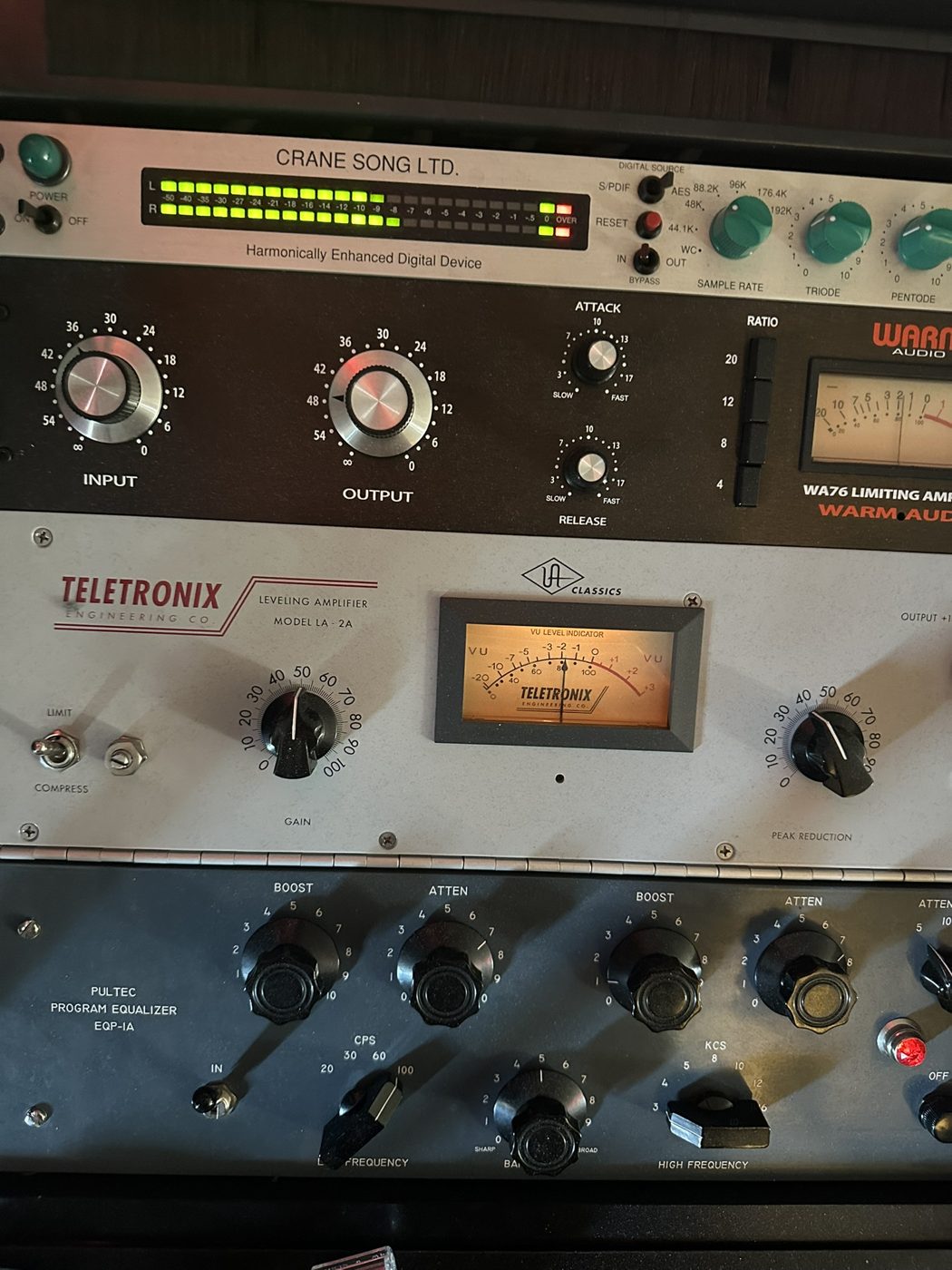
Born from riding faders
The LA-2A was designed by James F. Lawrence II, an engineer who had worked on optical sensors for the Titan missile program at the Jet Propulsion Laboratory. Working in radio in Los Angeles, he got tired of riding faders to keep levels even, and set out to build a box that would do it for him.
He founded the Teletronix Engineering Company in Pasadena, California in 1958, and the LA-2A followed in 1962. Teletronix was sold to Babcock Electronics in 1965, and in 1967 Bill Putnam's Studio Electronics, later UREI, took over the brand. The original run ended in 1969.
After a couple of limited reissues, Universal Audio, refounded by Putnam's sons in 1999, brought the LA-2A back into full production that same year. That's the version in the RAD rack.
How it works
Inside is the T4 optical attenuator: an electroluminescent panel that glows brighter as the audio gets louder, facing a light-sensitive cadmium sulfide cell. More light means more gain reduction. There's no ratio, attack or release knob; the physics of the light and the cell decide all of that.
Attack averages around 10 milliseconds. Release happens in two stages: roughly the first half in about 60 milliseconds, then the rest over one to fifteen seconds, depending on how hard and how long it has been working. That slow, program-dependent recovery is a big part of why it sounds so natural. A tube make-up gain stage brings the level back up, and a front-panel switch flips between Compress and Limit.
Where it shines
The LA-2A is best known on vocals and bass guitar. It has smoothed lead vocals on records like Nirvana's Nevermind and Alanis Morissette's Jagged Little Pill. Because it reacts gently, you can push it into several dB of gain reduction and the singer still sounds like they're performing, not being squeezed.
A typical approach: set the Gain for the level you want, then turn up Peak Reduction until the meter settles into a few dB of movement on the loudest phrases. On bass, it evens out the notes and fills out the low mids.
Quick facts
- Designer: James F. Lawrence II, Teletronix Engineering Co.
- Introduced: 1962, Pasadena, California
- Gain reduction: T4 optical cell (light panel plus photoresistor)
- Controls: Gain, Peak Reduction, Compress/Limit
- Back in production: Universal Audio, 1999